Hello! You're here because you wanted to read something about ferrets. Well, in about ten seconds you'll be taken to our new site, where all this information is-- just look at the table of contents on the side, and you'll find it!
If you are familiar with ferrets, you have undoubtedly heard that blaze ferrets are more prone to deafness than other ferrets. This is true. The reason behind it is a genetic condition known as Waardensburg Syndrome.Waardensburg Syndrome results in the underdevelopment of the cochlear of the inner ear, and is found in ferrets with white heads* such as blazes, pandas and DEWs. The same genetic codes that cause the ferret to have a white head can also cause the ferret to be deaf or hard of hearing. This is not to say that ALL ferrets with white heads ARE deaf, simply that they are genetically predisposed to deafness. In other words: ferrets with white heads are not all deaf, but they are MORE likely to be deaf than, say, sable ferrets.
*Albinism is caused by a genetic condition which is entierly different than Waardensburg Syndrome; albinism is not an indication of deafness but, due to the complications with eye development resulting from lack of pigment, albinism in ferrets has been attributed to poor(er) eyesight and potential blindless
Because we have been into lists lately, here is a list of 5 'golden rules' that help make life with ferrets a LOT easier!
1) Ferrets are not dogs. They cannot be trained like dogs. The sooner that you accept this, the happier you both will be.
2) Ferrets will NEVER use their litters 100% of the time. Period. End of story. The very best that you can hope for is 90%. Caging, flicking, yelling at, giving time outs, scruffing and any other type of discipline that you can think of (appropriate or not) will NOT help rectify this. Ferrets just don't care - their litter is the nearest corner or, if they are angry with you, any spot that you will notice (though definitely NOT in the litter box).
3) Taboo = fun for ferrets. If they know that a room is off limits, for example, a ferret will wait for the door to open and try to race you inside. Once inside they will often run about, bouncing, dooking, and doing the war dance. Disciplining for this is, well, pointless - ferrets won't understand why you hate their game so much, and will continue this game... in fact, by disciplining, you have made it MORE taboo and appealing!
4) Pick your fights. Overdoing discipline will lead to a stressful relationship between you and your ferret, and make discipline ineffective. Something worth disciplining your ferret for may include attempting to bite the family cat because the ferret is in a grumpy mood and that cat is there. This could be an opportunity to use a time out. Disciplining for the following: not using kitty litters, stealing objects, climbing over barriers, onto counters, under door, digging up plants, digging food, etc is NOT a good idea - it is a pointless waste of time that will stress both of you out.
***If your ferret constantly gets into areas that he or she is not allowed, you should be the one being disciplined, not your ferret; it is up to YOU to ferret proof in order to keep the ferret out, not up to your ferret to know to stay out!
5) Ferrets will be ferrets. They do 'ferrety' things such as stealing and hoarding random objects, missing their kitty litters, digging their food and your plants, sleeping in random places, getting into your stuff, knocking things over, getting where they aren't supposed to go and so on... if you don't like it (or feel the need to discipline the animal over such occurrences), they aren't the pet for you. The sooner that you are able to accept that discipline will not stop your ferret from being a ferret, the sooner the both of you can get on living and enjoying each others company. (Yes, I know that this is a bit of a repetition, but the point needs to be stressed!)
Enjoy your little critters for what they are: Ferrets!
For those of you new to the ferret world, or perhaps just looking for some new approaches to disciplining your ferret, here is a list of DOs and DON'Ts that will help give you the tools to teach your ferret how to behave without becoming the bad guy. ***DON'Ts are things that may injure your ferret, render discipline ineffective, or damage your relationship with your ferret. In other words: to foster a happy and fulfilling realtionship with your ferret, don'ts should be avoided AT ALL COSTS!
DOkeep in mind that every ferret reacts differently to different forms of discipline - what works on one may not necessarily work on another; it is best to try multiple approaches until you figure out what works for your ferret.
DON'T nose flick!!! Besides being mean (a ferret's nose is very sensitive) and teaching your ferret that people are something to fear, nose flicking can lead to permanent damage of the nasal cavity.
DON'T spank, smack or hit your ferret in any way!!! These forms of 'discipline' border on abuse and tend to lead to less than friendly relations between ferrets and their owners. Remember: ferrets are SMALL ANIMALS - what may seem like a light tap on the bottom to you is in fact a jarring full body blow to a ferret. You wouldn't appreciate a large hockey player body checking you every time that you did something wrong, so why replicate the feeling by smacking your pet? DO use time outs. They can give you and your pet a brief cool-down period.
DON'T use the cage as a time-out room. Doing so will cause your ferret to associate his cage with punishment and will leave him wondering what he did wrong come bedtime!
DON'T give more than 5 minute time outs. Any more than 5 minutes and your ferret will forget why he or she is IN time out, making the time out pointless.
DO try squirting the ferret with a spray of water for misbehaving. I find this one effective for deterring unwanted carpet and couch digging/ scratching for both ferrets AND cats.
DO use a firm "NO" to let your ferret know when he or she is doing something bad. I recommend using the firm "NO" before a time out, or in conjunction with a spray or a scruff, though it can be effective on its own.
DON'Tyell at your ferret!!! You may frighten your ferret, and a ferret that considers humans to be a source of fear is not a happy ferret.
DO scruff your ferret and say "no". A gentle scruff and drag can also be effective for curbing nipping and other unwanted behaviour some in ferrets.
DO use praise to reinforce good behaviour. Positive re-enforcement is always a good thing, and the odd treat along the way certainly doesn't hurt.
DO pay attention to how your ferret reacts to different forms of discipline to determine what is effective for your ferret. At the moment, I have one ferret that reacts negatively to the "scruff and drag" but responds well to time outs and the firm "no". I have another ferret that responds to praise, but ignores the firm "no" and is impervious to time outs (he cannot be scruffed due to injuries sustained in his previous home).
Good luck figuring out what works for your ferret, and avoid DON'Ts like the plague!!!
Yes, it exists! For those new to the ferret world, you have undoubtedly heard other ferret owners and enthusiasts speak of feeding their little carpet sharks duck soup, or of their hobs, jills, sprites, furkids, digboxes, n-bones, ferretvite etc, etc, etc....
Here is a quick guide to help you grasp "ferret lingo" so that you too will be able to "speak ferret" with the best of them!
Adrenal: A ferret with adrenal disease. For more information on this or various other ferret diseases, read "Ferrets for Dummies" by Kim Schilling.
Ferret suffering from advanced adrenal disease.
ADV: Aleutian's Disease Virus. Debilitating and incurable disease originally spread to ferrets by the Aleutian mink. Awareness of this disease is spreading in Canada and the United States. Ferrets can be carriers without showing signs themselves. For more information on this or various other ferret diseases, read "Ferrets for Dummies" by Kim Schilling.
Bib: Ferret pattern (see previous entry "Checkered Ferrets" for detailed description and photo)
Bonded: Two or more ferrets that have been together so long that they are virtually inseparable. Separating a bonded pair is NOT recommended as one or more of the ferrets may become depressed and refuse to eat following separation.
Bonded pair of ferrets
Carpet shark: Ferret (because they like to glide along the carpet and sometimes attack toes)
Cheweasles: Edible rubber textured chew treat for ferrets. Similar products include: Superchews by Marshall and Edible Chew treats (also by Marshall)
DEW: Dark Eyed White - ferret colour (see previous entry "Colour Me Ferret" for detailed description and photo)
Digbox: Container filled with dirt, sand, rice, beans or similar for ferret to dig in (see "Toy Tips" for more information on digboxes and other great ideas for ferret entertainment!)
Dook: Sound made by ferrets when they are happy. Here is an example (approximately 30 seconds in)
Duck Soup: High protein diet for sick ferrets; contains no duck, but a mixture of baby food, soft cat food, soaked kibble and other ingredients. Named after the creator's ferret "Duck", there are now about a million different recipes with each recipe claiming to be the best.
Ferrents: Ferret owners (or ferret parents)
Ferretvite (also known as Furovite): ferret vitamin supplement and treat. The best stuff (with taurine added) comes in a tube and has a molasses-like colour and texture.
Ferretone (also known as Furotone): ferret coat supplement and treat. This is an oil that most ferrets go nuts for!
Foamy Fries: edible foam - textured chew treats for ferrets.
Ferret enjoying foamy fry edible chew treat
Furkids: Ferrets
Fuzzbutts: Ferrets
Fuzzies: ferrets
Giggle: See dook.
Guardhairs: Coarse outer hairs on a ferret's coat (see previous entry "Colour Me Ferret" for detailed description)
Gib: Altered male ferret
Happy Dance: Sign of a happy and playful ferret. The ferret hops and flips about with its mouth open. Really good example of a happy dance can bee seen approximately 30 seconds in.
Hob: Unaltered male ferret
Hood: Ferret pattern (see previous entry "Checkered Ferrets" for detailed description and photo)
Jill: Unaltered female ferret
Marshall ferret: ferret from a large ferret mill in the United States. Ferrets are generally known for their laid back temperment and can be identified by two blue dots tattooed into one of the ears.
Milled ferret: Ferret from a large ferret mill such as Marshall as opposed to a private breeder. Some claim that milled ferret are more prone to cancers and other diseases common to ferrets, but it is more likely that this is due to the small ferret gene pool in North America.
Mitt: Ferret pattern (see previous entry "Checkered Ferrets" for detailed description and photo)
nbones: edible ferret chew treat intended to help keep your ferret's teeth clean.
Nbone chew treats for ferrets.
Rat tail: May be a sign of Adrenal Disease in ferrets; swelling of the adrenal glands causes, among other things, the ferret to lose the hair beginning at the base of their tail. This disease is serious and any ferret exhibiting signs of the disease should be taken to a knowledgeable ferret vet for treatment immediately. For more information on this or various other ferret diseases, read "Ferrets for Dummies" by Kim Schilling. Hair loss beginning at the END of the tail, however, is probably NOT adrenal disease. This pattern of hair loss (assuming that it does not progress up the ferret's back) is associated with tail acne (which can be treated by washing the affected area with anti-bacterial soap daily) or possibly related to heat. The hair on the tip of the tail may grow back during the next coat change, but this is not always the case.
Hair loss related to acne or heat. Notice how the baldness does not extend to the base of the tail.
Adrenal pattern tail baldness - hair is thinning on the tail, INCLUDING at the base.
Real Canadian Ferret: Like Marshall, Real Canadian is a large ferret mill. Ferrets from this mill are often considered to be larger in size than Marshall ferrets, and slightly more ranbunctious (though I have seen rambunctious Marshalls and laid back Real Canadian ferrets, so I don't buy into the stereotype). These ferrets can be identified by small X (for females) or Y (for males) tattoos in their ears.
Roan: Ferret colour (see previous entry "Colour Me Ferret" for detailed description and photo)
Sable: Ferret colour (see previous entry "Colour Me Ferret" for detailed description and photo)
Sprite: Altered female ferret
War Dance: See happy dance.
Woozel: Ferret
If you can think of any ferret lingo not on this list, or hear something a want to know what it means, please feel free to comment or e-mail me!
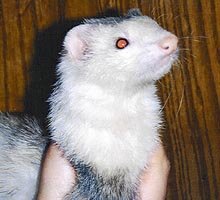 Waardensburg Syndrome results in the underdevelopment of the cochlear of the inner ear, and is found in ferrets with white heads* such as blazes, pandas and DEWs. The same genetic codes that cause the ferret to have a white head can also cause the ferret to be deaf or hard of hearing. This is not to say that ALL ferrets with white heads ARE deaf, simply that they are genetically predisposed to deafness. In other words: ferrets with white heads are not all deaf, but they are MORE likely to be deaf than, say, sable ferrets.